
Degrees Still Matter… But They’re No Longer the Golden Ticket
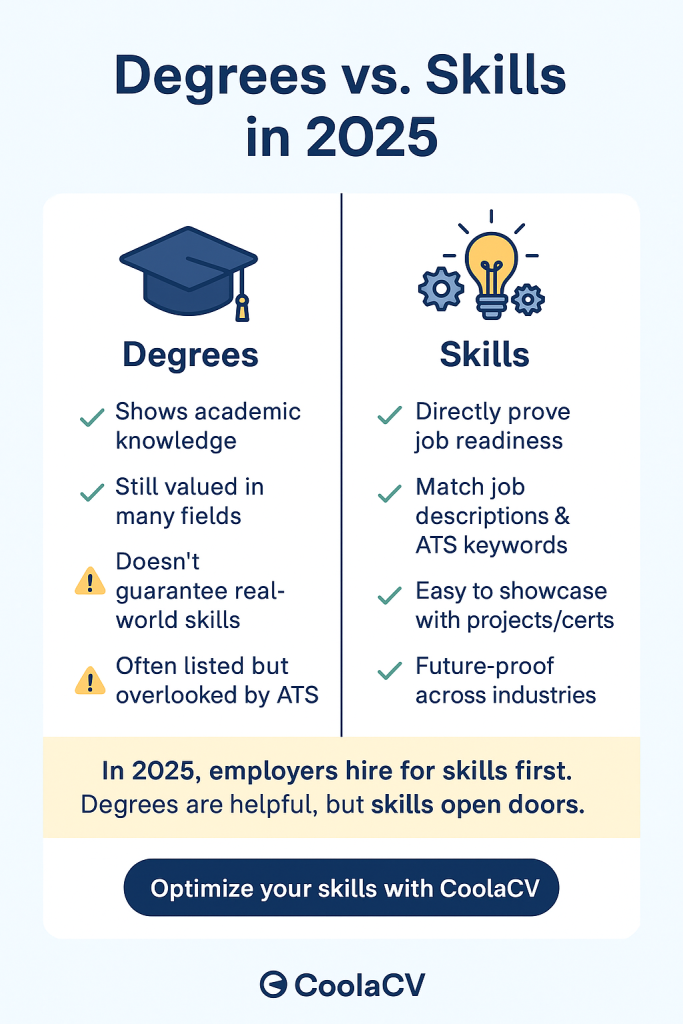
For decades, getting a degree was seen as the one-way street to a stable career. But in 2025? That’s changing fast. Employers are realising that a diploma doesn’t always prove you can do the job. What they want are skills: the ability to code, write, analyse, communicate, adapt, or use new tools like AI.
And if you don’t have those skills on paper? A degree alone won’t carry you as far as it used to.
The Big Shift: From Credentials to Capabilities
Companies like Google, IBM, and even some government agencies now offer jobs where a degree is “nice to have,” but not required. Instead, they’re testing for practical skills:
- Can you write a SQL query?
- Can you manage a project with real deadlines?
- Can you collaborate across teams?
The logic is simple: skills can be applied immediately, while degrees don’t always show real-world readiness.
Story Time: Meet Daniel
Daniel studied political science but ended up feeling stuck in entry-level admin roles. Instead of going back for another degree, he took a six-month UX design course and built a small portfolio.
Guess what? Within a year, he landed a UX role at a growing startup. Not because of his degree but because he proved his skills.
Stories like Daniel’s are everywhere now. That’s the shift we’re living in.
So, What Skills Are in Demand in 2025?
Here are some hot ones (and the list keeps growing):
- AI literacy (prompting, analysis, understanding automation tools)
- Data skills (Excel, SQL, Python basics)
- Communication & collaboration (remote teamwork is here to stay)
- Adaptability & resilience (because jobs are evolving faster than ever)
- Green skills (sustainability and energy roles are on the rise)
Okay, But What Can You Do About It?
Here’s the part that matters: you don’t need to throw out your degree, it’s still valuable. But you should pair it with visible, practical skills.
- Take short, targeted courses
Platforms like Coursera, Udemy, and LinkedIn Learning let you build skills in weeks, not years. - Build a project portfolio
Employers love to see proof. Create a GitHub repo, design mockups, or even volunteer your skills. - Show it on your resume
Don’t just list degrees. Highlight skills, certifications, and projects. That’s what gets noticed in ATS scans. - Use job descriptions as your guide
Look at 3–5 roles you want. Spot the recurring skills. Then make sure your resume reflects them.
How CoolaCV Helps You Highlight Skills (Not Just Degrees)
Here’s the problem: most resumes bury your degree at the top and let your skills hide at the bottom. That doesn’t cut it in 2025.
With CoolaCV, you can:
- Upload your current resume
- Paste in a job description
- Get real-time feedback on whether your skills align with what employers want
Example:
You upload a resume showing “BA in Economics” and “3 years in sales.” CoolaCV highlights that the job description calls for CRM skills, pipeline management, and data analysis, then suggests you emphasise those skills more clearly.
That way, your resume is tailored to today’s hiring reality: skills first, degree second.
The Takeaway
Degrees are still respected. But skills are the real currency in 2025. The faster you adapt, the more doors you open. So if you’ve been relying on your diploma to tell your story, it’s time to shift. Show employers what you can do.
And remember: you don’t need to start over. You just need to highlight the skills you already have and build new ones where it counts.
Ready to Make the Shift?
Upload your resume to CoolaCV, paste in a job description, and see how your skills stack up. Then fine-tune your resume so employers see the value you bring beyond the degree.