
The honest truth about “future jobs”
By the time a role hits job boards, the early seats are already taken. Teams quietly test titles, mix responsibilities, and only later publish a standard JD. So the trick isn’t predicting a perfect title. It’s reading signals and shaping your resume around the problems companies are trying to solve.
This guide shows you how to do that step by step.
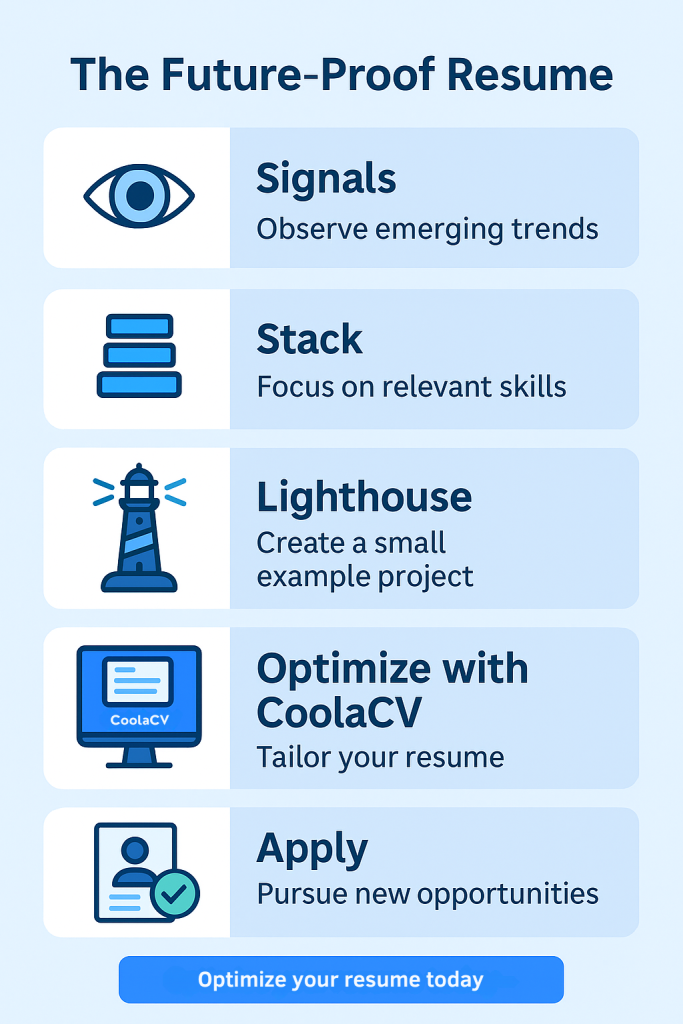
Step 1: Watch the signals (where new roles are born)
You don’t need a crystal ball. Look for patterns in four places:
- Product updates & roadmaps – New features create new operational needs (think: “AI features → AI enablement, red-teaming, data labeling ops”).
- Compliance & risk news – Regulations drive hiring (ESG reporting, AI governance, privacy ops).
- Tool ecosystems – When a tool wins mindshare (GA4, Looker, Snowflake, HubSpot, ServiceNow), “power user” jobs follow.
- Team experiments – Hybrid titles in posts (“Ops/Analyst,” “AI Trainer,” “Automation Success”) are early prototypes.
Mini-habit: Track 10 companies you like. Skim release notes, careers pages, and LinkedIn titles monthly. Note repeated words.
Step 2: Build a “skills stack” instead of chasing titles
Future roles are really skill bundles. Pick one problem space and stack 6–8 skills around it.
Examples
AI Enablement / Adoption
- Prompting + evaluation basics
- Change management & training
- Data hygiene, privacy awareness
- Tools: ChatGPT, Claude, Notion AI, internal LLMs
Sustainability / ESG Data Ops
- Data gathering & assurance
- Life-cycle metrics, emissions factors
- Tools: Excel/SQL, Power BI/Looker, reporting frameworks (GRI/CSRD)
Automation Success (RevOps/Support/IT)
- Process mapping & triage
- RPA/low-code tools (Zapier, Make, Power Automate)
- API literacy, logging, incident notes
Pick one stack. That’s your direction for 4–6 weeks.
Step 3: Ship “lighthouse” proof (tiny but undeniable)
Future-proof resumes show evidence, not just interests. Create one lighthouse per stack:
- A one-page case study (problem → action → outcome)
- A public mini-repo/Notion page with screenshots
- A training deck or SOP you’d actually use on day one
Examples you can finish in a weekend
- AI Enablement: “Rolled out prompt library for support macros; cut handle time 12% in pilot.”
- ESG Data Ops: “Built scope-3 data tracker in Looker; reconciled supplier data for 40 SKUs.”
- Automation Success: “Automated CRM lead enrichment via API + Zapier; reduced manual entry 90%.”
Step 4: Restructure your resume for tomorrow (layout that lands)
Use a skills-first structure that ATS and humans both get:
Header: Name · Location/Remote · Email · LinkedIn/Portfolio
Value Summary (2–3 lines):
A clear thesis: “Ops generalist turning AI-enablement specialist; shipped training, playbooks, and guardrails for non-technical teams.”
Skills Stack (grouped):
- Data/AI: SQL (basic), GA4, Looker Studio, LLM prompts/evals
- Automation: Zapier, Make, APIs, webhooks
- Ops: SOPs, change management, stakeholder training
Experience (impact bullets only):
Each bullet = Outcome + Lever + Scope
“Reduced time-to-resolve –18% by building AI-assisted triage rules in Zendesk; rolled out to 3 teams.”
Projects / Case Studies (linkable):
Short list with URLs or QR codes.
Learning & Credentials:
Micro-certs, courses, workshops. Keep it real, no fluff badges.
Step 5: Use “proxy JDs” to target roles that aren’t posted yet
No official posting? No problem. Build a proxy:
- Collect 3–5 adjacent JDs (e.g., RevOps + Automation + AI Trainer).
- Combine repeated skills into a composite description.
- Tune your resume to that composite.
Then, when a real posting appears, you’re already aligned.
Step 6: Optimise to what companies say they want (with CoolaCV)
When a live JD drops:
- Upload your current resume to CoolaCV (PDF/DOCX).
- Paste the job description.
- CoolaCV highlights keywords you’re missing, suggests role-specific phrasing, and checks ATS formatting.
- Generate a matching cover letter, then tweak the opening line to reflect your lighthouse project.
Rerun after edits until your alignment score climbs. You’ll see exactly where to tighten.
You can read: How to Use CoolaCV to Optimise Your Resume Without Starting From Scratch.
Step 7: Title ideas you can pre-target (emerging role examples)
Use these as search terms and resume headings:
- AI Enablement Specialist / AI Trainer / GenAI Program Coordinator
- ESG/Impact Data Analyst / Sustainability Reporting Ops
- Automation Success Manager / RevOps Automation
- Data Product Operations / Synthetic Data Coordinator
- Robotics/Edge Field Technician (for IoT/warehouse automation)
- AI Risk & Safety Ops / Model Evaluation Associate
You’re not guessing, rather you’re mirroring the problems companies are signalling.
Step 8: LinkedIn tweaks that attract “pre-JD” attention
- Headline: “Automation Success | Zapier/Make + CRM Ops | Built AI triage playbooks (–18% TTR)”
- About: 4 lines, one lighthouse link, one stack list, one “open to” sentence.
- Featured: Pin your best case study + a short post summarising it.
Recruiters search by skills + outcomes. Make those scannable.
Copy-ready bullets (steal these patterns)
- “Cut onboarding time 32% by mapping process and automating steps in Make + HubSpot.”
- “Built GA4 + Looker pipeline; gave marketing a weekly ROI view across 5 campaigns.”
- “Created prompt library with do/do-not patterns; improved macro accuracy +21%.”
Swap tools, metric, and scope. Keep the shape.
A 30-day plan to future-proof your resume
Week 1 – Signals & Stack
- Pick one stack and 10 companies to watch.
- Draft a composite JD from adjacent roles.
Week 2 – Lighthouse
- Ship one tiny, public artifact.
- Write a 6-sentence case note.
Week 3 – Resume Upgrade
- Restructure to skills-first.
- Tune with CoolaCV against your composite JD.
Week 4 – Visibility
- Update LinkedIn headline + Featured.
- Send 8 warm messages; apply to 6 targeted roles.
The mindset shift that changes everything
Don’t wait for a title to bless your move. Act like the role already exists: build proof, talk the language, help people solve the problem. The interview is often a formality after that.
Your next tiny step
- Pick one stack.
- Create a 1-page lighthouse this weekend.
- Upload your resume to CoolaCV, paste a related JD, and accept two phrasing tweaks.
That’s your future-proof resume — built today, ready for tomorrow.