
Let’s get one thing out of the way
The job market isn’t “broken.”
It’s just… different.
And if you’ve been feeling confused about what to learn, where to pivot, or whether your current skills still matter—you’re not behind. You’re actually right on time.
Because according to nearly every major workforce report released in the past year, skills, not job titles, are now the real currency of work.
Let’s break down what that actually means, what skills are rising fastest, and how to position yourself without burning out or going back to school.
First: What the data is actually saying
Across multiple reports (World Economic Forum, LinkedIn, McKinsey, OECD), a few patterns keep repeating:
Skills change faster than roles
Most jobs aren’t disappearing. They’re evolving.
Your title may stay the same, but the tools, expectations, and outputs are shifting fast especially with AI entering everyday workflows.
Employers are hiring for adaptability
Not perfection. Not credentials.
They’re looking for people who can learn, adjust, and apply tools quickly.
Degrees still matter but they’re no longer the filter
Hiring managers now scan for:
- Skills
- Tools
- Results
- Learning speed
Degrees alone don’t tell that story anymore.
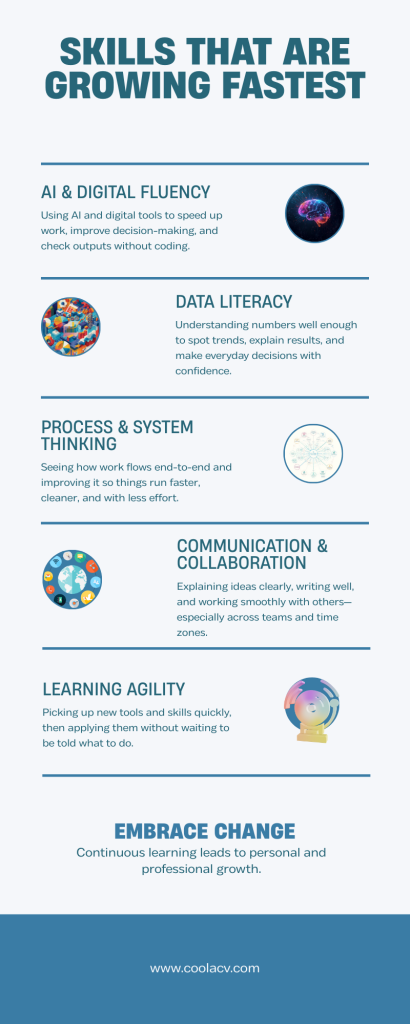
The 5 skill categories growing fastest right now
These aren’t guesses. They show up consistently in job postings and hiring data.
1. AI & Digital Fluency (Not Coding)
This surprises people.
Most companies don’t expect you to build AI. They do expect you to know how to work with it.
That includes:
- Writing clear prompts
- Using AI for research or drafts
- Reviewing AI output critically
- Understanding limitations and risks
If you can say:
“I use AI to speed up research, documentation, and analysis while validating outputs manually.”
You’re already ahead.
2. Data Literacy (Even at a Basic Level)
You don’t need to be a data scientist.
But you do need to:
- Read dashboards
- Spot trends
- Ask better questions
- Explain numbers clearly
Tools showing up everywhere:
- Excel / Google Sheets
- Power BI / Looker
- GA4
- SQL (basic)
Even basic familiarity makes you more employable across roles.
3. Process & Systems Thinking
This one is huge and underrated. Companies want people who can:
- Spot inefficiencies
- Document workflows
- Improve handoffs
- Reduce manual work
This shows up in:
- Operations
- Customer success
- HR
- Marketing
- IT
- Project management
If you’ve ever “made things run smoother,” you already have this skill.
4. Communication That’s Actually Useful
Not presentations. Not buzzwords. Real communication skills now mean:
- Writing clearly
- Explaining decisions
- Summarising complex info
- Working async
- Collaborating across teams
This is why strong written communication now ranks higher than public speaking in many roles.
5. Learning Speed (The Meta Skill)
This is the big one.
Hiring managers want people who:
- Learn new tools quickly
- Adapt without complaining
- Don’t panic when things change
- Can self-direct learning
You can’t fake this but you can show it.
The shift most people miss
Here’s the quiet truth:
Companies aren’t hiring for who you are. They’re hiring for what you can handle next.
That’s why resumes built around:
- responsibilities
- job descriptions
- static roles
…are getting ignored.
And resumes built around:
- outcomes
- tools
- learning
- adaptability
…are getting interviews.
So what should your resume look like now?
Not flashy. Not long. Just strategic.
Your resume should show:
- What problems you solve
- What tools you use
- How fast you learn
- What you’ve improved
- How your skills transfer
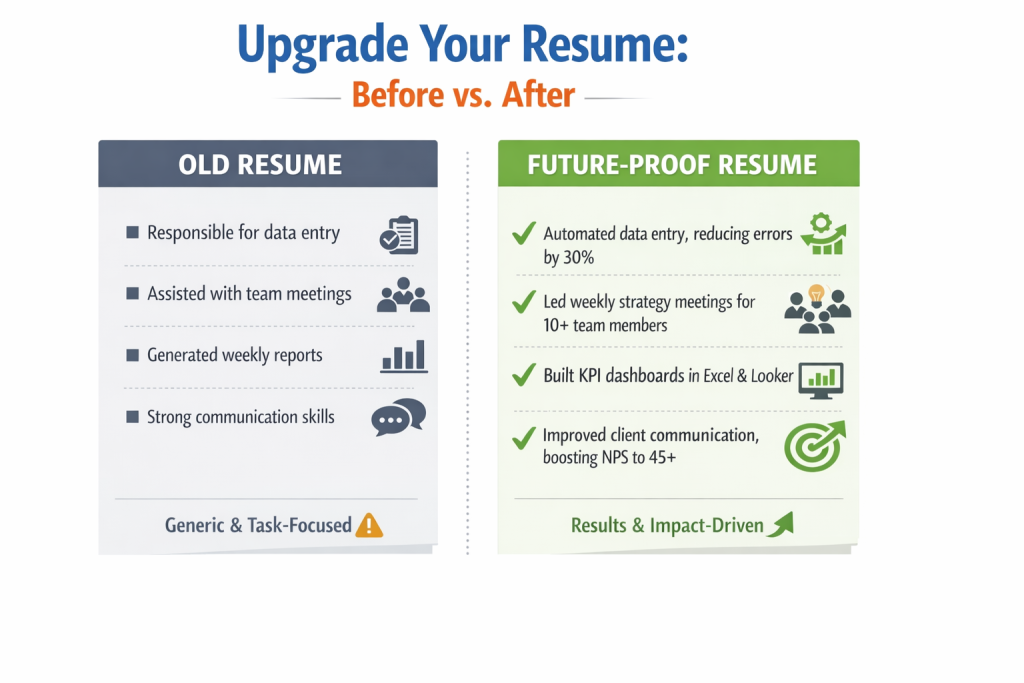
Instead of:
“Responsible for reporting and analysis”
Try:
“Built weekly performance dashboards in Excel and Looker; reduced reporting time by 40%.”
Same job. Completely different impact.
This is where CoolaCV helps (without rewriting everything)
If you already have a resume, you don’t need to start over.
With CoolaCV, you can:
- Upload your existing resume
- Paste a real job description
- See exactly which skills are missing
- Reword your experience to match market language
- Generate a tailored cover letter
It’s not about faking experience. It’s about translating what you already do into what employers understand.
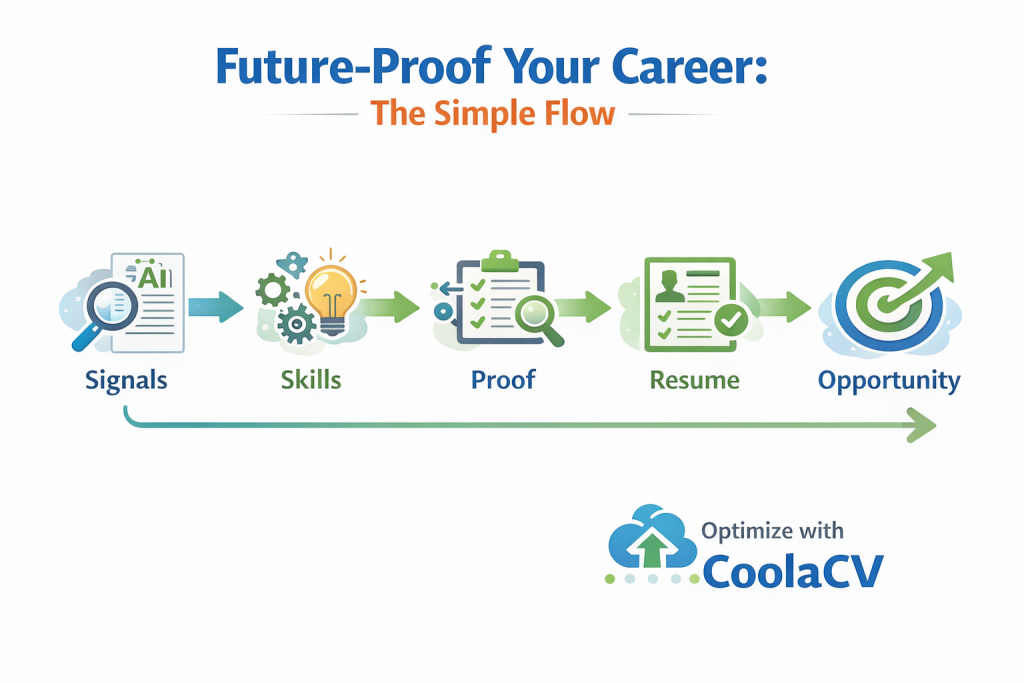
A simple way to future-proof yourself (30 minutes)
Try this today:
- Find 2 job ads you’d want in 6–12 months
- Highlight repeated skills
- Compare them to your resume
- Update 3 bullet points to reflect those skills
- Run it through CoolaCV to check alignment
That’s it. No overhaul. No panic.
The real takeaway
The future of work isn’t about chasing trends.
It’s about:
- staying curious
- learning in small loops
- documenting your growth
- and keeping your resume ready before you need it
If you do that, you won’t fear change but you’ll move with it.
Ready to future-proof your resume?
Upload it to CoolaCV, match it against real job descriptions, and see exactly where you stand.
Optimise your resume today — be ready before you need to be.
Very impressive 👍👍👍 God bless your efforts 🙏🙏🙏