
The moment you think, “Maybe it’s time…”
Maybe your role changed, your industry shifted, or you just want work that feels more you. I’ve been there. The scary part is the fog—“What could I do next?” The good part: you’ve never had more help than right now. AI won’t choose for you, but it will speed up the boring bits and make smart next steps obvious.
Below is a clear, no-fluff playbook.
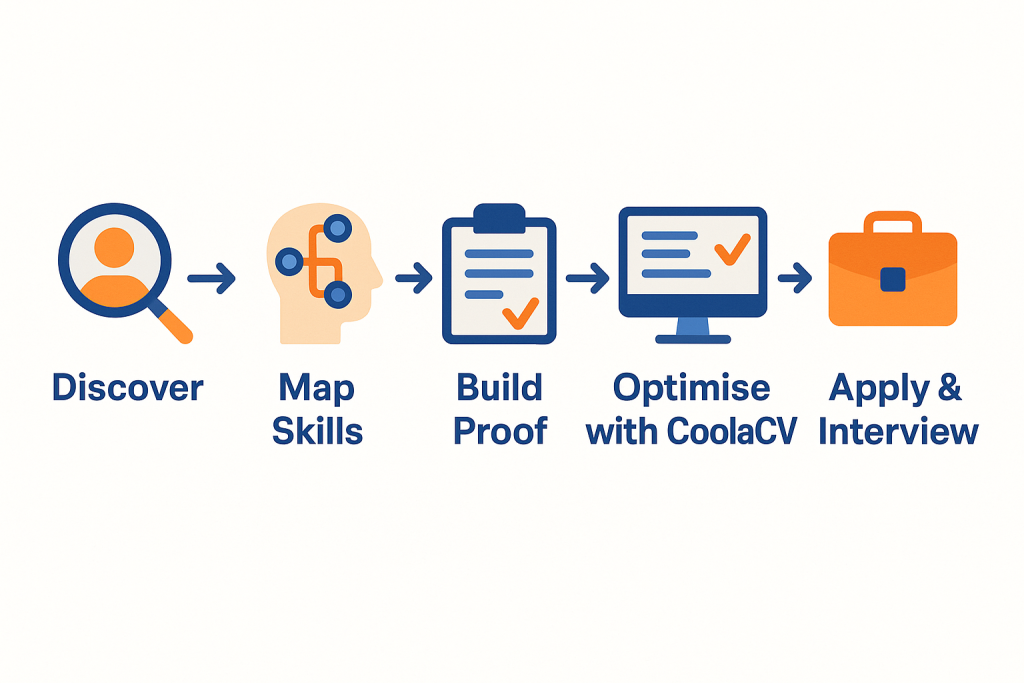
Step 1: Map your transferable skills (fast)
You don’t need to start over; you need to translate what you already do.
Try this (20 minutes):
- Pick 3–5 roles you’re curious about (e.g., RevOps, Product Marketing, UX Research).
- Paste those job descriptions into a notes doc.
- Ask an AI (ChatGPT, Gemini, Claude) to extract recurring skills and name adjacent titles.
Prompt you can paste:
“From these job descriptions, list the top hard and soft skills they share. Then suggest 3 adjacent roles I could target from [your current role], and the top gaps to close.”
You’ll see patterns quickly and that’s your short list.
Step 2: Choose a “direction, not destiny”
Don’t hunt for a perfect title. Pick one direction for the next six weeks. Example: “Data-fluent marketer” or “Support → IT Helpdesk.” This turns a vague pivot into a sprint you can execute.
Little story: Daniel (ex-customer support) aimed at “IT Helpdesk with basic scripting.” Six weeks later he had a lab notebook, two mini-certificates, and a resume that actually matched job posts.
Step 3: Build mini-proof with AI (not just certificates)
Hiring managers want evidence. Create small, real artifacts:
- Case study (1 page): problem → your action → measurable result.
- Portfolio snippet: a dashboard screenshot, a process map, a before/after onboarding flow.
- Public note: a short LinkedIn post summarizing what you learned this week.
AI to speed it up:
- Ask AI to outline the case study structure in bullet points.
- Use AI to clean up your writing not to invent wins.
Step 4: Tailor your resume with CoolaCV (skills-first)
Here’s where CoolaCV earns its keep:
- Upload your existing resume (PDF/DOCX).
- Paste a live job description for the role you want.
- CoolaCV highlights missing keywords, suggests role-specific phrasing, flags format issues, and generates a matching cover letter.
Example transformation:
- Before: “Handled 100+ customer emails daily.”
- After (for Helpdesk): “Resolved 30–40 technical incidents/day; triaged tickets in Jira; documented fixes to cut repeat issues by 18%.”
👉 How to use CoolaCV to optimise your resume without starting from scratch.
Step 5: Use AI for interview prep (without sounding robotic)
- Feed the JD + your resume to an AI and ask for likely interview questions.
- Practice STAR answers (Situation–Task–Action–Result).
- Ask AI to critique your answer for clarity and metrics.
Prompt you can paste:
“Based on this job description and my resume, generate 10 likely interview questions. For each, write a concise STAR answer using my actual experiences. Keep answers under 90 seconds.”
Record yourself once. You’ll hear where you ramble.
Step 6: Networking, the easy way (templates you can tweak)
AI won’t build relationships for you, but it can remove the awkwardness.
Warm ping:
“Hi [Name], I’m exploring [direction] and noticed your work at [Company]. Would you be open to a 15-minute chat about what success looks like in your team? Totally fine if timing’s tight.”
Referral follow-up:
“Thanks again for the chat. If it’s appropriate, would you feel comfortable introducing me to [Person/Team]? Here’s a 3-line summary you can forward.”
Keep it short. Be human. Always close with an easy yes/no ask.
Step 7: Automate your job search (so you don’t live in tabs)
- Set LinkedIn/Indeed alerts for 3–4 titles.
- Ask AI to cluster the posts by must-have skills, then prioritize.
- Save a master tracking sheet (Job, Date, Status, Contact, Follow-up). AI can draft it for you.
Prompt:
“Create a compact Google Sheet template to track job applications, including columns for role, link, skills match, date, contact, follow-up, and notes.”
Common pitfalls (and how to avoid them)
- Letting AI “invent” experience. Don’t. Use it to polish, not to fabricate.
- Chasing too many roles. Pick one direction, run a 4–6 week sprint, then reassess.
- Over-optimising the resume, under-building proof. A polished resume opens the door; projects keep it open.
A 4-week pivot plan you can actually follow
Week 1: Direction + skills map
- Pick target role.
- Gather 5 JDs.
- Ask AI for recurring skills & gaps.
Week 2: Micro-learning + first artifact
- One short course or official doc tutorial.
- Build a mini-project; draft a 1-page case study with AI’s help.
Week 3: Resume + cover letter
- Upload resume to CoolaCV; optimise against two JDs.
- Generate cover letter; tailor 2–3 bullets with metrics.
Week 4: Interviews + outreach
- AI-generated question bank; rehearse STAR answers.
- Send 10 warm messages; apply to 8–12 roles that actually fit.
Quick FAQ
Do I need to delete my degree?
No. Keep it—just lead with skills and outcomes. Employers hire for what you can do now.
Is using AI “cheating”?
Using AI to clarify, summarise, or format is normal. Making up achievements is not. If you’re proud to sign your name to it, you’re fine.
How many versions of my resume should I keep?
Two or three is plenty (e.g., “Data-curious marketer,” “Lifecycle marketer”). CoolaCV helps you pivot between versions quickly.
Your next tiny step (do it before you close this tab)
- Find one JD that excites you.
- Upload your resume to CoolaCV and paste that JD.
- Accept two wording changes, add one metric, and generate the cover letter.
That’s momentum. And momentum beats “someday.”