
Rejection hurts. Even when you “know it’s not personal.”
You can be qualified. You can do everything “right.”
And still get the email that starts with: “We’ve decided to move forward with other candidates…”
After a few of those, something shifts. You stop feeling curious. You start feeling tired.
So let’s make this practical.
Reddit is full of job seekers who are stuck, frustrated, and honest. But mixed into the chaos are patterns—things people keep repeating because they’re actually working.
Here’s what’s worth stealing.
1) They stopped mass applying and started matching hard
A common thread: people who apply to everything feel busy… and get nowhere.
What changed for the ones getting interviews?
They started treating each application like a match problem, not a lottery ticket.
What they do instead:
- Apply to fewer roles
- Only apply when they hit ~70% of requirements
- Make sure their resume mirrors the job description language (without copying)
Why it works:
Most resumes fail because they don’t sound like the job.
Try this today
Pick one job description. Highlight:
- core skills
- tools
- outcomes
- keywords repeated 3+ times
Then ensure those exact terms appear on your resume truthfully.
CoolaCV shortcut:
Upload your resume → paste the job description → CoolaCV flags missing keywords and phrasing gaps so you can fix them fast.
If you’re applying to everything out of frustration, this will help you narrow your search: How to find a job that’s a true cultural fit
2) They rewrote bullets to show outcomes, not tasks
Reddit job seekers keep saying the same thing in different words:
“My resume explained what I did… not what changed because I did it.”
This is the single biggest reason qualified people get rejected early.
What “better bullets” look like
Before:
- Responsible for weekly reporting.
After:
- Built a weekly KPI dashboard in Excel; reduced reporting time by 40% and improved visibility for leadership.
Same job. Completely different impact.
A simple bullet formula that works
Result + Action + Tool + Scope
- “Reduced ___ by ___% by doing ___ using ___ across ___.”
Even if you don’t have perfect metrics, you can estimate responsibly:
- time saved
- volume handled
- errors reduced
- turnaround improved
3) They started using “proof assets” instead of just claiming skills
This one is underrated.
A lot of Reddit advice boils down to: show, don’t tell.
People are building small proof pieces like:
- 1-page case studies
- mini portfolios
- simple dashboards
- process docs
- GitHub repos
- writing samples
- bug reports or test plans
Not giant projects. Just enough to prove they can do the work.
Quick proof ideas (by role)
- Marketing: 1-page campaign teardown + improvements
- Data: a simple dashboard from a public dataset
- Ops: a workflow map + SOP template
- QA: a test plan + bug report sample
- Customer success: onboarding checklist + renewal save story
Add the link under a “Projects” section. It signals you’re serious and it gives interviewers something real to react to.
4) They shifted from “job boards” to “human paths”
Reddit job seekers complain about job boards for a reason. They’re noisy.
People reporting better results tend to do this:
- apply on the company website
- find the hiring manager or team lead
- send a short note
- ask a smart question
- then apply
It’s not magic. It’s just less crowded.
A message that doesn’t feel desperate
“Hi [Name], I applied for the [Role] and wanted to send a quick note. I’m especially interested in how your team is handling [specific thing from JD]. If there’s anyone I should speak to or anything I should highlight in my application, I’d appreciate your guidance.”
Short. Calm. Specific. No begging.
5) They treated interviews like a “story problem,” not a personality test
Some Reddit users say they were getting interviews but failing at the final step.
The ones who improved stopped winging it.
They:
- built 6–8 prepared stories
- practiced STAR format
- kept answers under 90 seconds
- added numbers
- tailored stories to the job
Your “story bank” should include:
- a project you improved
- a time you solved a hard problem
- a conflict you handled
- a mistake you fixed
- a time you learned fast
- a time you influenced someone
You don’t need 30 stories. You need 8 strong ones.
6) They took breaks on purpose (and stopped spiraling)
This came up more than I expected.
A lot of job seekers are burned out, and burnout makes you sloppy:
- low-quality applications
- rushed answers
- angry cover letters (yes, really)
- no patience for learning
People are building recovery into the process:
- applying in batches
- taking weekends off
- walking before interviews
- limiting job boards to one hour/day
This isn’t soft advice. It’s performance advice.
A calm brain writes better resumes.
7) They stopped trying to be “perfect” and got strategic
This is the most useful mindset shift:
Rejection doesn’t always mean “not good enough.”
Sometimes it means:
- ATS didn’t read your resume correctly
- your resume didn’t match keywords
- internal candidate already existed
- the role wasn’t real (quiet freeze/ghost post)
- you were qualified but not clearly positioned
So instead of asking, “What’s wrong with me?”
they asked, “What part of the system did I not meet?”
That question is fixable.
Also, A lot of “rejection” is actually the market freezing. This breaks down how to stay ready: Layoffs, quiet freezes, and Plan B resumes
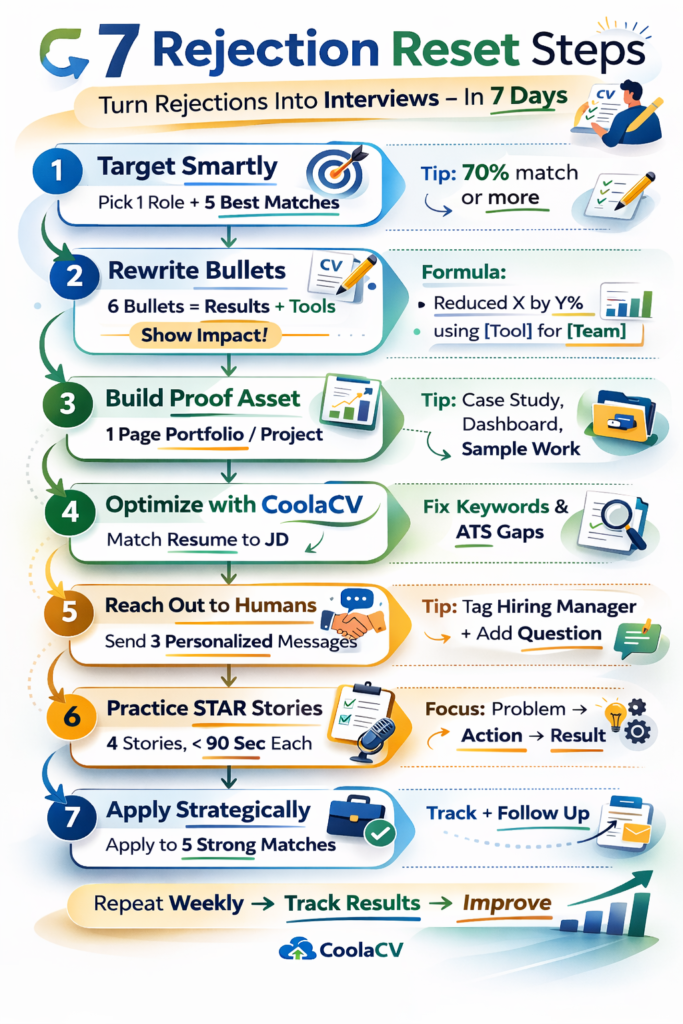
A simple 7-day “rejection reset” plan
If you’re stuck, do this for one week:
Day 1: Pick one target role and 5 job descriptions
Day 2: Rewrite 6 bullets to show outcomes + tools
Day 3: Build one proof asset (1 page)
Day 4: Run your resume through CoolaCV against a real JD
Day 5: Send 3 warm messages to humans (not boards)
Day 6: Practice 4 STAR stories (record yourself once)
Day 7: Apply to 5 roles you actually match
Repeat weekly. Adjust based on results.
Where CoolaCV fits (without extra effort)
CoolaCV is especially useful when rejection is happening because your resume isn’t translating correctly.
Use it to:
- check ATS compatibility
- match your wording to the job description
- surface missing keywords
- generate a cover letter that sounds like you
- keep Plan A / Plan B resume versions ready
This isn’t about tricking the system. It’s about making sure your real skills don’t get filtered out.
The takeaway
Rejection doesn’t mean you’re failing. It means your current approach needs a smarter loop.
The Reddit job seekers getting results aren’t doing wild hacks. They’re doing boring, effective things consistently:
- matching instead of mass applying
- showing outcomes, not tasks
- building small proof
- moving through humans
- preparing stories
- resting on purpose
Do that for two weeks and your results will change.
Your next tiny step
Pick one job post. Upload your resume to CoolaCV, paste the job description, and fix the top 3 mismatches.
Then stop.
Take a breath.
And apply with confidence because you actually match.
Header image by Freepik