
Career cushioning is not panic. It’s insurance.
Let’s talk about something a lot of people are doing quietly right now.
They’re not “looking” for a new job.
They’re not updating LinkedIn every day.
They’re not posting “Open to Work” with a green banner.
But they are preparing.
That’s career cushioning.
It’s the strategy of building options in the background so if layoffs hit, hiring slows, or your role changes, you’re not stuck scrambling.
And honestly? It’s one of the most adult things you can do for your career.
Why career cushioning is trending now
Because the job market has changed in a specific way. It’s not always loud layoffs. Sometimes it’s:
- hiring freezes that aren’t announced
- backfills that never get approved
- promotion cycles quietly paused
- teams shrinking through attrition
- “do more with less” becoming permanent
You can be doing your job well and still feel unstable. That’s not paranoia. That’s reality.
So people are cushioning.
What career cushioning looks like (in real life)
It’s not dramatic. It’s tiny habits. It’s someone who:
- updates their resume monthly instead of yearly
- keeps a short list of target companies
- stays lightly connected to past coworkers
- builds one skill that keeps them mobile
- saves proof of their work (metrics, wins, outcomes)
It’s quiet competence.
Career cushioning vs. job hunting: what’s the difference?
Job hunting is active. Career cushioning is preparedness.
| Job Hunting | Career Cushioning |
|---|---|
| Apply now | Prepare continuously |
| Big effort bursts | Small weekly habits |
| “I need a job” energy | “I want options” energy |
| Often emotional | Calm and strategic |
Career cushioning makes job hunting easier if it ever becomes necessary.
The Career Cushioning System (simple and sustainable)
You don’t need a big plan. You need a small system. I think about careers the same way I think about systems reliability, that is, build resilience before something breaks. I wrote about this mindset in How to Build an AI-Aware Test Strategy, and the same principle applies here: preparation beats reaction.
1) Keep a “Wins Log” (10 minutes a week)
This is the most underrated thing on earth. Every Friday, write 3 bullets:
- what you delivered
- what improved
- what number changed
Examples:
- “Reduced ticket backlog from 212 → 103 by rewriting triage workflow.”
- “Built weekly KPI dashboard; saved 2 hours per team per week.”
- “Improved NPS from 35 to 47 by updating onboarding emails.”
This becomes your resume fuel.
2) Maintain a “Plan B skills stack” (15 minutes a week)
Pick one direction you could move into if needed. Not a full career change. Just a nearby lane:
- CS → Implementation / Ops
- Marketing → Lifecycle / Growth
- QA → Automation basics
- Admin → Program support / Ops
Then build one skill slowly:
- GA4 or Looker Studio
- Excel dashboards
- Jira workflows
- Zapier/Make automations
- SQL basics
Small consistent learning beats random bursts.
3) Keep your resume “warm” (once a month)
This is where most people fall behind. They wait until something bad happens, then spend 8 painful hours rewriting their resume while stressed.
Instead:
- once a month, update 2–3 bullets
- add one fresh metric
- remove outdated clutter
You should be able to apply to a role within 60 minutes if you had to.
Where CoolaCV fits in (without extra work)
CoolaCV is perfect for career cushioning because it makes resume maintenance quick. Instead of rewriting from scratch, you can:
- Upload your existing resume
- Paste a job description for a role you might want
- See how well your resume matches
- Adjust a few bullets and keywords
- Save a fresh version
This is basically “resume rehearsal.” You’re not applying. You’re staying ready.
Even better: you can maintain Plan A / Plan B / Plan C resumes by optimising against different job descriptions—without rebuilding anything.
4) Do low-key networking (without being weird)
Career cushioning networking is not begging for referrals. It’s simply staying visible and connected.
Try these:
“Light touch” message
“Hey [Name], hope you’re well. I’ve been working on [project/area] recently and thought of you. Would love to catch up when you have time.”
Comment strategically
Leave thoughtful comments on posts from people in your target companies. This builds familiarity over time.
Keep a warm list
Pick 10 people you genuinely respect. Reach out once every 2–3 months. No agenda. Just connection.
That’s how opportunities find you quietly.
5) Build one “proof asset” per quarter
A proof asset is something you can show.
Examples:
- a short case study (1 page)
- a dashboard screenshot
- a workflow diagram
- a mini portfolio page
- a process guide
It makes your skills real. And it gives you confidence too because you’re not just saying you can do the work. You’re showing it.
The emotional benefit nobody talks about
Career cushioning reduces fear. Not because the world becomes stable but because you become prepared.
It’s a different feeling waking up and knowing:
- your resume is ready
- your skills are growing
- your network is alive
- your options are real
That’s calm. That’s power.
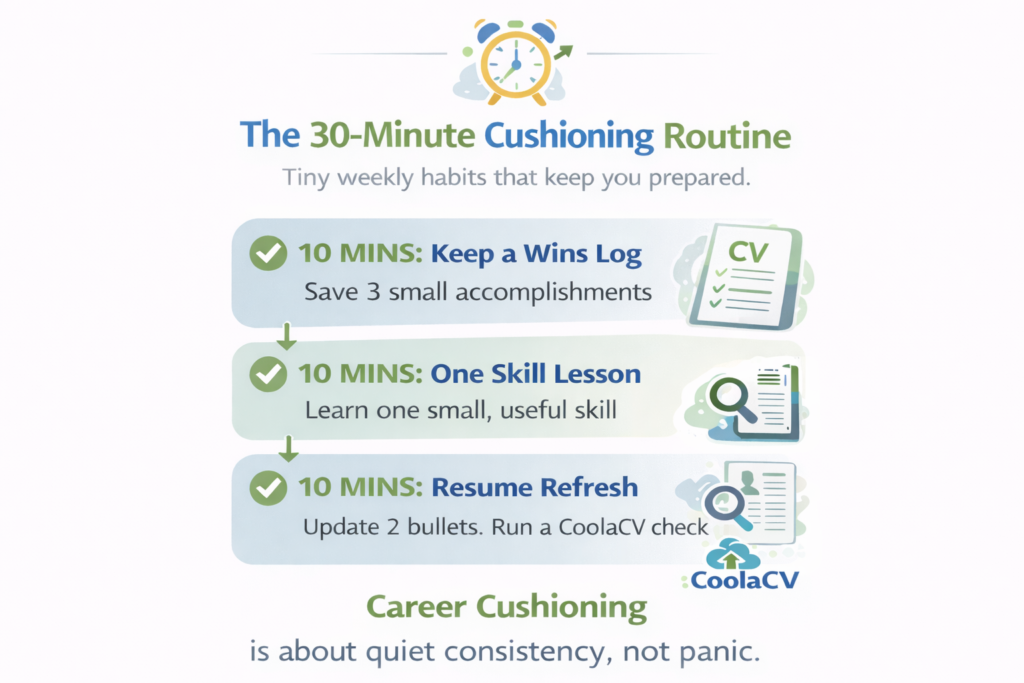
A simple weekly routine (30 minutes total)
If you want a tiny routine you’ll actually stick to:
✅ 10 mins: Wins log
✅ 10 mins: One skill lesson
✅ 10 mins: Resume refresh / CoolaCV check against a JD
That’s it.
That’s career cushioning.
Your next small step (today)
Open your resume. Pick one job description you’d like someday. Upload your resume into CoolaCV and see the gap.
Then fix just one thing:
- add one metric
- rewrite one bullet
- surface one relevant skill
You don’t need to do everything. You just need to stay ready.