Most people don’t need a brand-new resume. They need a resume that stops tripping over its own shoelaces.
Because applying with an old CV is like showing up to an interview with toothpaste on your shirt. You might still be brilliant… but now everyone’s distracted.
This is your 60-minute refresh which is a practical reset you can do before you apply anywhere. No perfection. No drama. Just the changes that actually move the needle.
Set a timer. Make a cup of tea (or coffee). Let’s do it.
Minute 0–10: Strip the formatting that breaks screening
Your resume should be easy for systems to parse and humans to skim.
Do this fast clean-up:
- Switch to a single-column layout.
- Remove tables, text boxes, icons, skill bars, and fancy sidebars.
- Use standard fonts (Calibri, Arial, Times New Roman—boring is beautiful).
- Keep headings simple: Summary, Skills, Experience, Education, Certifications.
- Make sure your contact info is plain text at the top (not floating in a header graphic).
Quick test: copy your resume into a plain text editor. If it turns into spaghetti, your formatting is doing too much.
Minute 10–20: Rewrite your “top third” (the part recruiters actually read)
You need to know what actually gets you through screening. Recruiters typically scan the top third of page 1 first. That’s where your resume either:
- feels instantly relevant, or
- gets mentally parked in “maybe later” (which is basically “no”).
Refresh these pieces:
1) Your headline (one line)
Use a title that matches the job you want:
- “Customer Success Manager | SaaS Onboarding | Retention”
- “QA Engineer | Automation + API Testing | Fintech”
2) Your summary (3–5 lines)
Use this structure:
- Who you are (role + scope)
- What you’re known for (strengths tied to the job)
- Proof (a metric or outcome)
- Tools/keywords (only the real ones)
Example:
QA Engineer with 8+ years supporting web and API releases across regulated environments. Known for reducing escaped defects through risk-based testing and clean test data practices. Recently improved regression speed by 30% by tightening suites and improving triage. Tools: Jira, Postman, Cypress, SQL.
No fluff. No “dynamic self-starter.” (If you’re dynamic, your results will show it.)
Minute 20–30: Steal the job description’s language (ethically)
This is not “keyword stuffing.”
This is speaking the employer’s dialect.
Open the job description and highlight:
- 5–8 hard skills/tools (e.g., Jira, Power BI, Salesforce)
- 3–5 responsibilities (e.g., stakeholder management, incident response)
- 2–3 outcomes (e.g., improve conversion, reduce defects, increase retention)
Now make sure those terms appear naturally in:
- Your summary
- Your skills
- Your most recent role bullets
Important: only keep keywords you can defend in a conversation and use job description keywords naturally.
Your resume is not a wishlist. It’s a receipt.
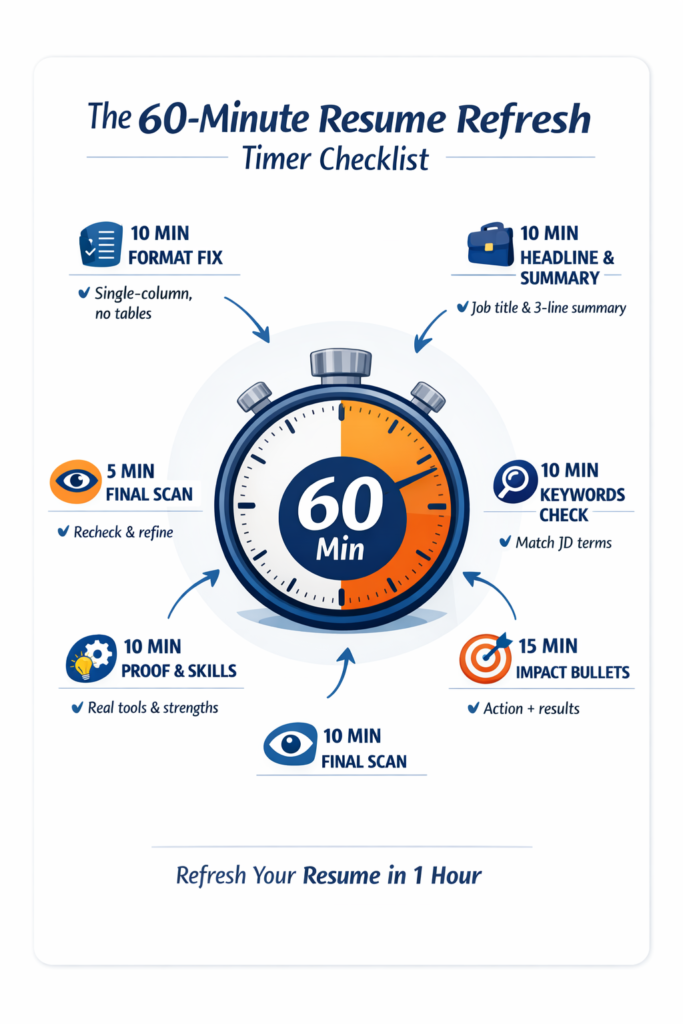
Minute 30–45: Upgrade your bullets (this is where interviews come from)
Most resumes fail here because they read like task lists.
The bullet upgrade formula
Action + what + how + impact (metric if possible)
Before:
- Responsible for reporting defects and supporting releases.
After:
- Logged and triaged defects in Jira, improving release readiness by tightening acceptance criteria and reducing repeat issues by 18% over two quarters.
If you don’t have metrics, use proof without numbers:
- reduced rework
- improved speed
- improved quality
- reduced risk
- increased consistency
- supported higher volume
Try this quick exercise:
- Pick your top 2 roles
- Rewrite 3 bullets per role
That’s only 6 bullets and it’s usually enough to make the resume feel “new.”
If your bullets start with “Responsible for…” your resume is officially in witness protection. Bring it back into the light.
Minute 45–55: Fix your skills section so it stops looking generic
Your skills section should support your story, not look like a LinkedIn bingo card.
Use 2–3 categories:
- Tools: Jira, Confluence, Postman, SQL, Excel
- Testing: Regression, UAT, API testing, test planning
- Delivery: Agile, stakeholder management, defect triage
Then, make sure at least half of those skills show up inside your experience bullets (proof matters).
Minute 55–60: The final “screening sanity check”
Do these three checks before you hit submit:
- Relevance check:
Does the first page clearly match the role you’re applying for? - Searchability check:
Can you find the job’s key terms in your resume in context, not just in a random list? - Skim test:
Read it like a recruiter with 30 seconds.
Do you immediately see role fit + evidence + clarity?
If yes, apply.
What this 60-minute refresh actually does
It doesn’t turn your resume into a masterpiece.
It turns it into something far more valuable:
- readable
- searchable
- credible
- job-matched
That’s what gets you through screening.
Ready to apply with a resume that fits the job?
If you’re applying soon, run your CV through CoolaCV with the exact job description you’re targeting and generate an ATS-friendly, job-matched version built for screening.
Try CoolaCV: Optimize my CV for this job