Today’s job interviews aren’t just about whether you can do the job. Employers also want to know how you’ll fit into their team’s dynamic, company mission, and workplace vibe. In fact, more hiring managers now use interview questions for culture fit to assess not just your skillset but your attitude, values, and work style.
Whether you’re interviewing with a startup or a Fortune 500 company, cultural fit job interviews are now standard. Knowing how to respond—and what to ask—can help you stand out for the right reasons.
Let’s dive into 7 interview questions that matter most when it comes to assessing cultural fit.
Section 1: Questions Employers Might Ask You (and How to Answer Them)
When hiring managers assess cultural fit, they’re listening for more than what’s on your resume. They want to know how you think, how you interact with others, and whether you’ll align with the company’s values and environment. These questions help hiring managers determine how well your personality and values align with their company culture. Be prepared to answer them thoughtfully and honestly:
Here are four common cultural fit questions—and sample responses that demonstrate how to answer with clarity and authenticity.
1. “What type of work environment helps you thrive?”
What they’re looking for:
They want to understand whether their team’s atmosphere matches your preferred work style—whether that’s collaborative, fast-paced, autonomous, or highly structured.
✅ Example response:
“I thrive in environments where collaboration is encouraged but people also have the space to work independently. In my last role, we had daily stand-up meetings to stay aligned, but I had ownership of my projects and the freedom to solve problems creatively. That balance helped me stay engaged and productive.”
2. “Describe your ideal manager.”
What they’re looking for:
This question helps interviewers see how your expectations match the manager’s leadership style. It’s also a subtle test of how well you understand professional dynamics. They’re checking for alignment with their leadership style. Do you value autonomy, or do you like regular check-ins and support?
✅ Example response:
“My ideal manager is someone who provides clear direction but trusts their team to execute. I appreciate constructive feedback and regular check-ins, but I also value autonomy. At my last job, my manager scheduled bi-weekly 1:1s where we discussed progress and roadblocks, which really supported my growth.”
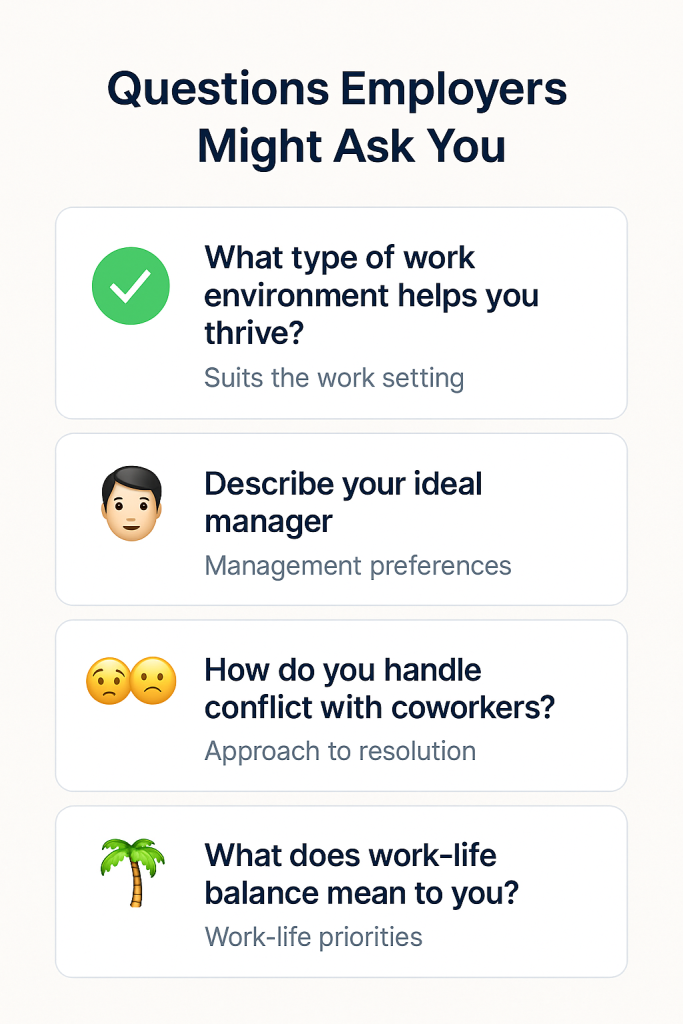
3. “How do you handle conflict with coworkers?”
This gauges emotional intelligence and collaboration. Use a real example to highlight communication, empathy, and problem-solving skills.
What they’re looking for:
Conflict is inevitable. Employers want to know you can handle disagreements maturely and professionally—without creating unnecessary tension or drama.
✅ Example response:
“I believe in addressing conflict directly but respectfully. When a disagreement came up on a project timeline with a teammate, I asked for a quick chat. We each shared our perspectives, clarified misunderstandings, and came up with a compromise. It ended up improving both the relationship and the project outcome.”
4. “What does work-life balance mean to you?”
What they’re looking for:
This helps them assess whether your definition of balance aligns with the company’s culture—and whether their policies will realistically support your needs. Be honest—but also reflect on how the company’s culture aligns with your personal definition of balance.
✅ Example response:
“To me, work-life balance means being able to fully focus during work hours and having the flexibility to disconnect after hours. I’m highly committed to my responsibilities, but I also believe that rest and personal time make me a more focused, creative employee. That’s why I value organisations that respect personal time and promote flexibility when possible.”
Section 2: Questions You Should Ask the Employer
Want to assess the company culture during your interview? These are key questions you can ask to make sure the role truly fits your values and personality:
5. “How does your team celebrate wins?”
This reveals how the company values accomplishments and whether recognition is part of their DNA.
6. “Can you describe the company’s communication style?”
You’ll learn whether communication is open, transparent, top-down, or collaborative—important for your day-to-day experience.
7. “What’s one thing employees say they love about the company?”
This encourages the interviewer to speak candidly. Their answer will offer insight into what really makes the company special—or if it’s just buzzwords.
Section 3: How to Prepare Authentic Answers
It’s not just about having a slick response—it’s about showing who you are and whether you align with what the company values. Here’s how to prepare:
✦ Self-Reflection is Key
Before your interview, ask yourself:
- What energizes me at work?
- What kind of leadership helps me grow?
- What values are non-negotiable for me?
Your answers should shape how you respond in the interview—genuinely and confidently.
✦ Align with Their Values (But Don’t Fake It)
Review the company’s mission, vision, and values. Try to find overlap with your own. But remember: you’re not trying to force a match—you’re looking for a mutual fit.
✦ Avoid Generic, Scripted Answers
Instead of saying “I’m a team player,” share a short story that shows how you’ve collaborated effectively in a previous role. Real examples resonate more than buzzwords.
Final Thoughts
Cultural fit interviews are about more than getting hired—they’re about finding a place where you’ll be respected, challenged, and empowered to do your best work. Preparing for these questions helps you and the employer make the right choice.
Need to craft a cover letter that reflects your personality?
Let CoolaCV’s AI do the heavy lifting—tailor your story for the companies that truly get you.